Where is Russia Today?
Casting a light on global Russian military activity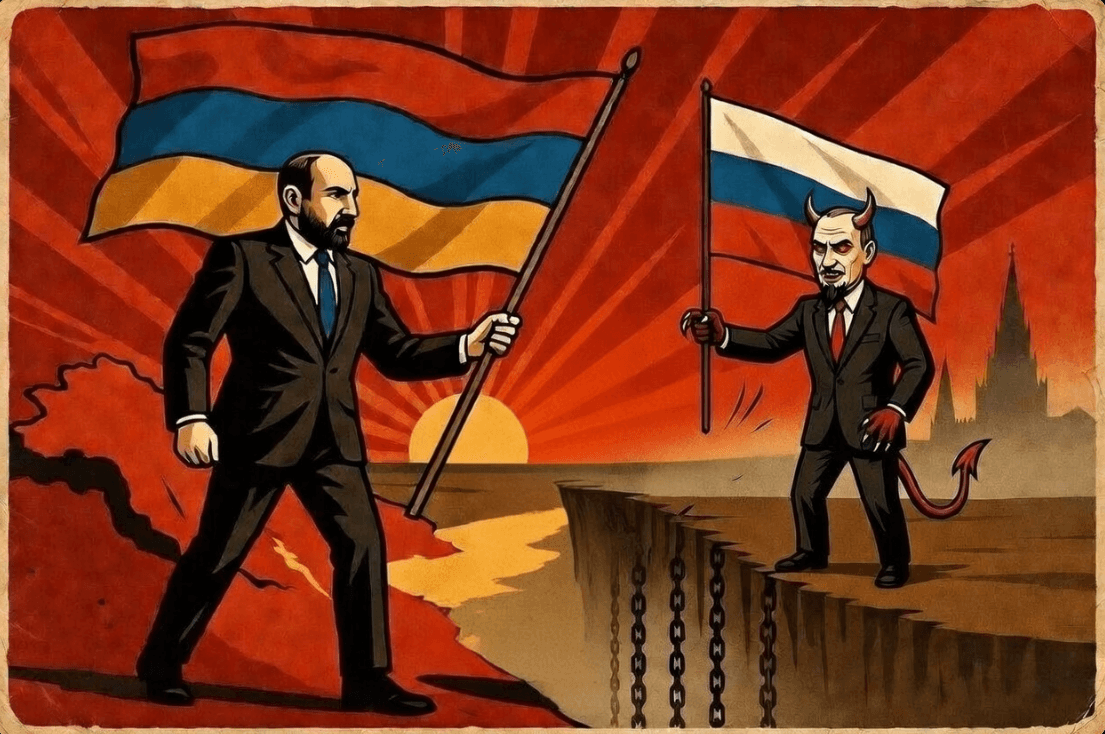
Sympathy for the Devil
Decoding the elements of Armenia's pro-Russian support network.
Armenia is undergoing a significant geopolitical shift, as it further reassesses its long-standing relationship with Russia and explores closer ties with the West. This transition has created a volatile political environment in which historically dominant Russian influence is shrinking, amid increasing scrutiny. In response, Moscow-linked actors, political networks, and media entities are widely believed to be attempting to shape Armenian domestic politics, particularly ahead of elections and constitutional debates that could redefine the country’s geopolitical orientation.
Armenia’s Strategic Drift Away from Russia
For decades after the collapse of the Soviet Union, Armenia was one of Russia’s closest partners in the South Caucasus. Moscow maintained extensive political, economic, and military influence, including through the Russian 102nd Military Base in Gyumri and Armenia’s membership in Russian-led institutions such as the Collective Security Treaty Organization (CSTO).
Similarly, the concept of ‘Russkiy Mir’ (Russian World) has become an important ideological framework underpinning Russian cultural and political influence across the post-Soviet space. According to analysis published by the European Centre for Constitutional and Political Thought, the concept describes a transnational community bound together by the Russian language, culture, historical memory, and Orthodox traditions.
The Russkiy Mir foundation is a key element of this concept. Founded in 2007 via Presidential Decree under Vladimir Putin, it was set up by the Ministries for Foreign Affairs and Science and Education. The foundation’s main purpose is to promote all the above ideas, while also connecting the Russian diaspora abroad and other Russian speakers worldwide. Although often presented as a cultural project, the concept has increasingly been integrated into Russian foreign policy as a mechanism for maintaining influence beyond the borders of the Russian Federation. For these reasons, following the full-scale invasion of Ukraine in 2022, Russkiy Mir was sanctioned by the EU, USA and multiple other Western states.
Within this framework, post-Soviet states, including Armenia, are frequently framed as part of a broader civilizational space historically connected to Russia. The promotion of this ideology is carried out through a network of cultural institutions, educational initiatives, and diaspora organizations designed to reinforce Russian cultural ties. In Armenia, where Russian-language media, cultural centers, and diaspora networks remain partially influential, such initiatives contribute to maintaining a Russian presence in the country’s social and political landscape. Critics argue that while these programs are often presented as cultural cooperation, they also function as instruments of soft power intended to shape public opinion and attempt to sustain Russia’s geopolitical influence in the region.
However, relations between Armenia and Russia deteriorated significantly after the 2020 Nagorno-Karabakh war and subsequent regional developments. Armenia’s leadership increasingly criticized Moscow for failing to guarantee Armenian security during conflicts with Azerbaijan. Prime Minister Nikol Pashinyan has openly questioned the benefits of Russian military presence and signaled interest in closer cooperation with Western partners.
Public opinion has evolved alongside these geopolitical shifts. Polling shows that Armenian society increasingly favors stronger ties with the West while still maintaining pragmatic relations with Russia. One survey found that 49% of Armenians favored a pro-Western orientation, though most within that group still preferred a balanced foreign policy rather than a complete break with Moscow.
Trust in Russia has also fallen dramatically in recent years. Surveys show that only about 31% of Armenians view Armenia–Russia relations positively, a sharp decline from more than 90% before the Nagorno-Karabakh war.
Further emphasizing this distrust, the Armenian Foreign Intelligence Service released a statement to Armenpress, stating it had gathered intelligence to suggest that ‘various actors, presenting themselves as representatives of the special services, are attempting to exert pressure on Armenians abroad, namely in a specific country, to support certain political parties’. Whilst the country itself is not named, the deliberate use of the phrase ‘Special Services’ is an indicator that the individuals may be of Russian origin.
Russian-Leaning Sympathizers, Political Actors and Networks
Despite declining public trust in Moscow, several Armenian political figures and groups remain closely aligned with Russian interests.
One of the most prominent figures is Samvel Karapetyan, a Russian-Armenian billionaire with deep ties to Russia’s business and political elite. Karapetyan was recently declared a candidate for prime minister by his newly formed ‘Strong Armenia’ political party, despite being legally ineligible due to holding multiple citizenships and not residing in Armenia for the minimum required four years.
His candidacy illustrates how wealthy diaspora figures connected to Russia can still play an overstated role in Armenian politics. Strong Armenia have even suggested pursuing constitutional changes that would allow him to assume office if they were to win power at the upcoming election.
Karepetyan’s Brother, Karen Karepetyan, was the former President's chief of staff. He has been subject to media scrutiny previously, given his political ties, but especially in light of Samvel’s business interests.
Karen’s son, Narek Karepetyan, has emerged as a notable political actor in Armenia, closely tied to the Strong Armenia Party led by his uncle. Narek serves as the party’s primary organizer and public representative and is set to head its candidate list for the parliamentary elections scheduled on June 7, 2026, despite the actual candidate being his Uncle, Samvel. In addition, Narek coordinates the grassroots initiative known as ‘Mer Dzevov’ (Our Way), which forms the base of the party’s organizational structure. Within the party, he acts as a transitional coordinator, overseeing the electoral campaign, shaping strategic messaging, and managing operations.
Other political actors have also been associated with pro-Russian sentiment. For example, the New Times party, led by Aram Karapetyan (no relation) has historically advocated a Russophile orientation in Armenia’s foreign policy.
Political Instability and Allegations of Regime Change
Beyond formal political parties, Armenia’s powerful oligarch networks, many of which developed during the post-Soviet period, retain economic ties to Russia. These networks often influence media narratives, political campaigns, and grassroots mobilization, creating potential channels for Russian influence.
The Armenian government has increasingly accused pro-Russian actors of attempting to destabilize the country. In 2025, authorities arrested several prominent critics of the government, including aforementioned billionaire Samvel Karapetyan and influential cleric Bagrat Galstanyan, over allegations that they were involved in plots to overthrow the government.
These accusations came amid large protests against government policies following territorial concessions to Azerbaijan. Opposition groups mobilized tens of thousands of demonstrators demanding Pashinyan’s resignation. Critics claim the arrests were politically motivated, though government officials maintain they were part of a broader effort to prevent destabilization by entrenched oligarchic and pro-Russian networks. The tensions illustrate the growing polarization within Armenian politics between pro-Western reformists and sympathetic factions that favor maintaining traditional ties with Moscow.
Russian Military Presence and Public Perception
Russia’s military presence remains one of the most sensitive issues in Armenia’s foreign policy debate. Approximately 5,000 Russian troops are stationed in the country, primarily at the Russian 102nd Military Base in Gyumri and garrisoned in Yerevan. Alongside these troops are various armored elements, air defense and EW units. Near Yerevan, co-located with the Armenian Air Force, Russia has stationed MiG-29 fighter jets and other aviation assets at Erebuni airbase.
Historically, the base was seen by many Armenians as a critical security guarantee against regional threats, particularly from Azerbaijan and Turkey. Russia presents the base’s existence and military presence as a stabilizing force that does not threaten local or regional security. Yet public attitudes toward the Russian military presence are increasingly mixed. While older generations often view Russia as a traditional ally, younger Armenians and reformist political groups see Russian security guarantees as unreliable after Moscow’s perceived inaction during recent regional conflicts.
This shift in Armenian foreign policy and perception of Russia has fueled debate about whether Armenia should diversify its security partnerships and reduce reliance on Russian military infrastructure.
The Importance of the Upcoming Constitutional Referendum
A key factor driving Russian interest in Armenian politics is the possibility of constitutional reforms that could reshape the Yerevan’s orientation.
Armenia has been discussing major constitutional changes that could accompany a peace treaty with Azerbaijan and potentially remove references to territorial claims related to Nagorno-Karabakh. Such reforms could also facilitate closer integration with Western institutions. More importantly, the prospect of a referendum on deeper integration with the European Union has gained traction. Polls show growing public support for EU membership, with more than half of Armenians expressing support for joining the EU in hypothetical referendums.
For Moscow, a referendum represents a direct threat to its geopolitical influence in the South Caucasus. Armenia’s departure from Russian-led economic and security structures would weaken Russia’s regional strategic position and reduce its leverage over regional transport corridors and energy routes.
Consequently, Russia has strong incentives to interfere with Armenian public opinion and political processes ahead of any referendum that could move the country away from the sphere of Russkiy Mir influence and further towards the West.
Media and Information Influence
Russia’s influence in Armenia also operates through media and information channels. Russian-language media outlets remain widely consumed in Armenia, particularly among older audiences. State-backed outlets such as RT, Sputnik, and RIA Novosti regularly publish content about Armenian politics.
These outlets often promote narratives emphasizing Armenia’s economic dependence on Russia, the dangers of Western influence, and the importance of traditional alliances. This messaging can contribute to disinformation campaigns aimed at shaping public opinion during elections or referendums.
A notable proponent of this disinformation on behalf of the Kremlin’s wider media system is the Rybar Telegram channel. Rybar has a large following within Telegram, and also in various social media spaces. It has covered Armenia heavily within its content across all platforms, conforming to narratives including; the current Armenian Government is anti-Russian, Yerevan is hostile to pro-Russian elements of Armenian society, Russia is Armenia’s only reliable security partner and Armenia drifting away from the CSTO and towards the West is at Russia’s expense.
Armenian authorities have even sought international assistance to counter what they describe as Russian disinformation campaigns targeting the country’s political process ahead of upcoming elections.
A Political Crossroads
Armenia now finds itself at a geopolitical crossroads. The country’s leadership is increasingly exploring Western partnerships, while a portion of the political elites remain connected to Russian networks.
Russian-backed political actors, oligarchs, and media outlets continue to play an active role in Armenia’s domestic political landscape. Whether through support for specific candidates, influence operations in the media sphere, or attempts to shape constitutional debates, Moscow retains multiple levers of influence.
Yet Armenian public opinion appears to be shifting. While many older citizens still support maintaining pragmatic relations with Russia, the youth and media are increasingly Europe-facing, and the broader trend points toward a reorientation toward Europe and the West.
The outcome of upcoming elections, constitutional reforms, and potential referendums will likely determine whether Armenia continues the steady drift away from Moscow’s grasp, or whether Russia succeeds in preserving its influence over one of its historical allies in the South Caucasus.